In July we reached out to neighbors and members asking for help in our emergency plan to save just a few of Airdrie Forest's magnificent, heritage American beech trees from Beech Leaf Disease. Thanks to everyone’s generosity and matching Conservancy reserves, we've now taken the first big step to save eight spectacular specimens. Here's our progress report.
The disease is caused by an invasive nematode Litylenchus crenatae, which overwinters in infected leaf buds, causing leaves to become malformed, thickened, shriveled, and shed, typically from the lower canopy up. In a few years, the tree is dead.

A set of infected leaves on a tree in Airdrie Forest Preserve
However, there is a treatment that significantly reduces nematode numbers in dormant buds and prevents leaf symptoms and dieback. The treatment is injected directly into the vascular system of trees before the nematode enters the leaf buds in late summer.
Thanks to the initiative of Preserve neighbor Rebecca Linder, the Conservancy contracted with Alex Roberts of Mountain Arborist in Phoenixville to perform the treatment. Alex worked with Rebecca and Conservancy volunteers to identify good candidates for the treatment: trees that are large, still relatively healthy, and near trails, for ease of treatment and most readily appreciated by visitors. Alex applied the treatment during the first week of August in a scientific process that requires the nematicide solution to be carefully measured into about a dozen gallons of de-ionized water per tree, then pumped into the root flares with just enough pressure that the tree takes up the solution in its transpiration process. All of which required carrying power and water into the Preserve.
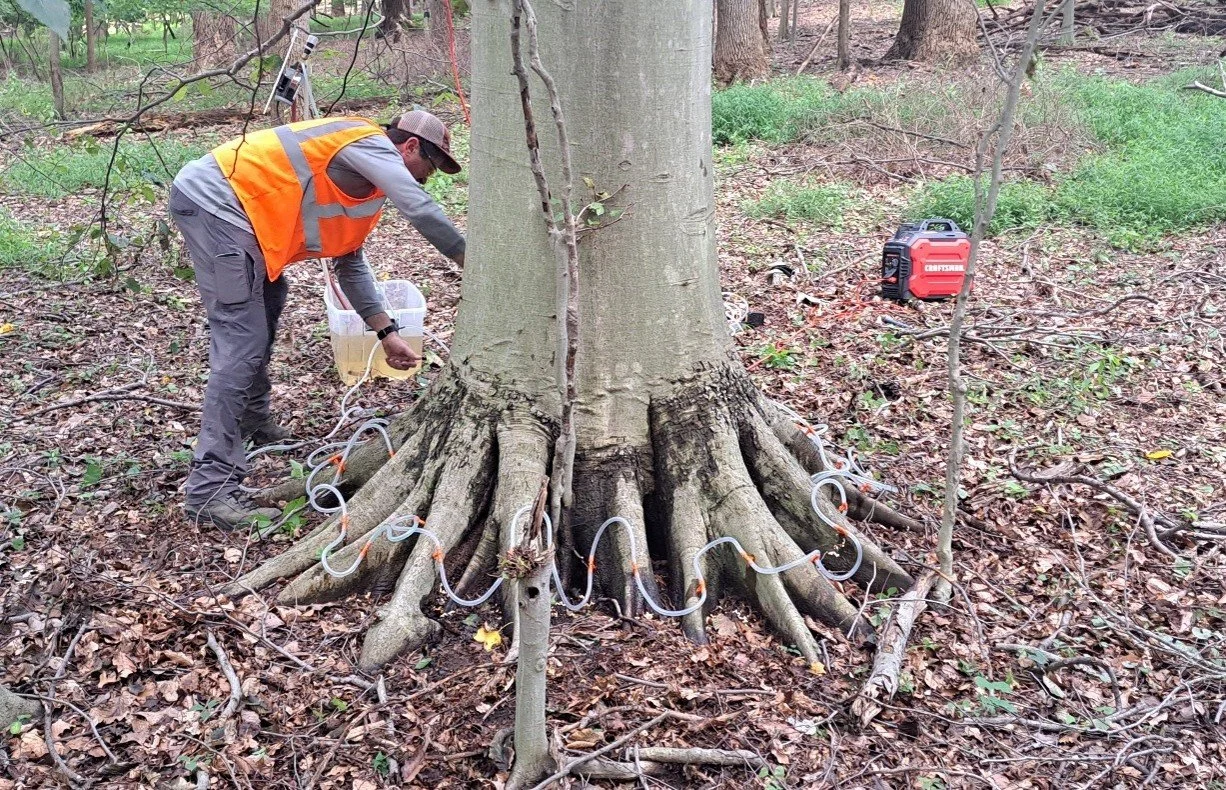
Alex setting up the injection system, with his portable generator to the right and the pump system and treatment tank behind him to the left.
The treated trees are in Airdrie East: four along the trail at the southern edge, and four by the trails at the NW corner. For now, the trees are marked with blue tape; we'll be replacing that with permanent tags, so please look out for them!
We expect that the treated trees will be significantly healthier next year, with full recovery by the next year. Although that will then be the time to apply the treatment again, to keep the nematode at bay for another two years. We're planning, also, that next year we'll be able to treat just a few of the most magnificent trees in the Conservancy's other upland forest, in Diamond Rock Preserve.
To those of you who have helped, thank you! To everyone, please keep our Beech trees in your heart and mind going forward. Truly, you would be helping to preserve our heritage. [Click here to donate to the Beech Tree Fund] Please clarify in the comments that this is for the Beech Tree Fund.